


Clean and fresh groundwater
In Rovaniemi, the water quality is so good that tap water requires no treatment at all, or only very minimal treatment. For example, no chemicals are added to the water in the Rovaniemi city centre area. Napapiirin Vesi Oy’s water supply area is very extensive, covering the municipality of Rovaniemi as far as Lohiniva, Autti, Tiainen and Jaatila. The network has a total length of approximately 1,800 kilometres.
The water in Rovaniemi is very soft. For this reason, you can use detergent sparingly, and there is no need to add water softening salts to dishwashers or washing machines.
In Rovaniemi’s groundwater areas, it is extremely important to observe the recommendations and restrictions relating to activities in these areas in order to maintain excellent water quality. These guidelines cover, amongst other things, construction, agriculture and forestry, as well as industrial and commercial activities. Please refer to the guidelines in the following PDF: General guidelines on recommendations and restrictions to be observed in Rovaniemi’s groundwater areas.
DELICATE HANDLING
Water treatment is a delicate process. The correct acidity (pH value) of the water is ensured by passing it through a limestone filter into the network where necessary. The growth of any bacteria is prevented by UV (ultraviolet) light treatment.
Bacteria are rarely found in domestic water, and the iron, copper and manganese levels in the water are not high. In Rovaniemi, the water’s pH is slightly acidic. Radon is present only in some areas, but it dissipates from the distribution network before reaching properties.
WATER QUALITY RISK ASSESSMENTS
Under Section 20 of the Health Protection Act, the self-monitoring carried out by a water supply operator and the monitoring of domestic water quality must be based on the assessment and management of risks affecting the health-related quality of the water. Risk assessments must be carried out in cooperation between operators and the authorities. Napapiirin Vesi Oy has carried out a separate risk assessment for each water supply area, which have been reviewed with the health protection authority. The risk assessments are updated regularly.
Based on the risk assessments, risk factors identified in the water supply areas included, for example, road gritting, landfill sites and soil extraction. Napapiirin Vesi Oy monitors the quality of drinking water at water intake points, water treatment plants, water reservoirs and consumer tap points in accordance with the 2021–2025 monitoring programme.
HIGH-QUALITY WATER
In Rovaniemi, the water is of good quality and bacteria are rarely found in drinking water. Our water is soft, and the iron, copper and manganese concentrations are not high. Below is some further information on aspects relating to water quality and properties that are monitored.
The concentrations shown in the tables are annual averages for the central urban area. Analysis results and more detailed information on the various water supply areas can be viewed:
Key figures for water supply areas (links to the website https://www.vesi.fi/)
or contact quality specialist Annika Moberg, tel. 040 186 6145, annika.moberg@neve.fi.
Water quality data for the Napapiirin Vesi supply area, PDF.
BACTERIA
The presence of bacteria in domestic water indicates water contamination. The presence of coliform bacteria in water supplied by a water utility is a sign of inadequate water treatment, particularly disinfection. The presence of coliform bacteria may also indicate that surface water has entered the well, that the well has become overgrown, or that soil has entered the water supply network.
No coliform bacteria should be detectable in good-quality domestic water. The presence of E. coli or enterococci in domestic water is a sign of faecal contamination. E. coli originates exclusively from human or animal faeces.
IRON AND MANGANESE
Iron and manganese cause unpleasant tastes and odours in domestic and drinking water, as well as discolouration of the water and plumbing fixtures. They can also cause stains on laundry.
If the water is safe to drink based on its appearance and taste, the iron concentration is at a level that does not pose a health risk. Manganese can cause a black, sooty-like sediment to form in the water. At high concentrations (>100 µg/l), manganese may pose a health risk.
ACIDITY
The acidity or alkalinity of water is described by its pH value. The pH value of water is a very important factor in relation to water supply materials. If the water is slightly acidic, the materials used in water distribution systems, such as cast iron, galvanised steel, copper, concrete and asbestos cement, will usually corrode unless the water has been alkalised.
A pH range of 6.5–8.8 is considered suitable. To minimise corrosion, the pH should be as stable as possible. If the pH value is below 7.0 – i.e. the water is acidic – it is possible that the dissolution of metals from pipes and the soil will increase.
ELECTRICAL CONDUCTIVITY
Electrical conductivity indicates the amount of salts dissolved in the water. The higher the salt content, the higher the water’s conductivity and the greater the damage it causes to water equipment and pipework.
WATER HARDNESS
Water hardness indicates the amount of calcium and magnesium salts present in the water. The more of these substances there are in the water, the harder it is classified as being.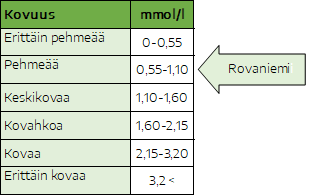
COPPER
A high copper content in domestic water gives the water a metallic taste, turns sanitary fittings green and may turn light-coloured hair green. Copper usually originates from the property’s copper water pipes and is particularly prevalent in hot water. Acidic water (pH < 7) prevents the formation of a protective oxide layer on the copper, which can lead to corrosion in copper pipes. Running the water reduces its copper content, but does not eliminate the risk of pipe corrosion.
RADON
Radon dissolves in water and causes a radiation dose in the stomach. A radiation dose always carries a risk of cancer.
SUSPICION OF CONTAMINATION
Domestic water contaminated with intestinal pathogens may cause an intestinal infection, the symptoms, onset and duration of which depend on the pathogen. The most common symptoms are diarrhoea, nausea, abdominal pain and fever. (Valvira, Guideline 3/2016.)
Legionella bacteria cause infections through the growth of Legionella bacteria in a building’s water systems and subsequent exposure via inhalation of aerosols containing the bacteria.
If Legionella bacteria are suspected to be the cause of the problem, you should contact the THL’s Legionella experts immediately. This ensures that measures and sampling are correctly targeted and that exposure is minimised as far as possible. (Valvira, Guideline 3/2016.)
SAMPLING
Napapiirin Vesi Oy takes samples of domestic water in accordance with its monitoring plan. The timing of sampling depends on the water supply area. If you wish to have the water quality at your property analysed, you can order a sampling from Eurofins Ahma Oy at your own expense. Napapiirin Vesi Oy takes individual samples as directed by the authorities.
No additional water samples are taken in response to individual reports. If you suspect that your tap water is contaminated, you can contact the local authority’s environmental health customer service on 0400 128447 or send an email to terveystarkastaja@rovaniemi.fi.


